machine learning, ai, cs · publications
Extending HER to visual domain with GANs
Cover story for the research paper by Himanshu Sahni, Toby Buckley, Pieter Abbeel and Ilya Kuzovkin
Addressing Sample Complexity in Visual Tasks Using Hindsight Experience Replay and Hallucinatory GANs
ICML 2019 Workshop on Reinforcement Learning for Real Life
An end-to-end reinforcement learning (RL) process starts with an agent that randomly interacts with the environment, hoping to score some rewards purely by chance. Those rare occasions when the roaming agent stumbles on a reward (or on a penalty) constitute the learning experience. All other time is spent learning nothing and is wasted.
To address that obvious waste of resources, a technique called Hindsight Experience Replay (HER) was introduced in 2017 by M. Andrychowicz et al. Imagine that the goal of the agent is to reach a location . But after some roaming around it ends up in location . Usually we would discard the trajectory that led to and learn nothing from it. In HER, however, we pretend that , and not , was the intended goal. This way the agent will learn what to do if, at some point in the future, its task is to reach the location .
At OffWorld we are trying to apply RL to real physical robots. This makes the problem of high sample complexity especially acute: all those wasted trajectories cost time, energy, and maintenance of a physical robot and its spare parts. While in games and simulation-based RL reducing sample complexity is a nice-to-have, in robotics it often defines whether the learning will be feasible or there is no point in even attempting it. This is why we are looking at all possible sample complexity reduction techniques and implementing them within our systems. HER is one of those techniques.
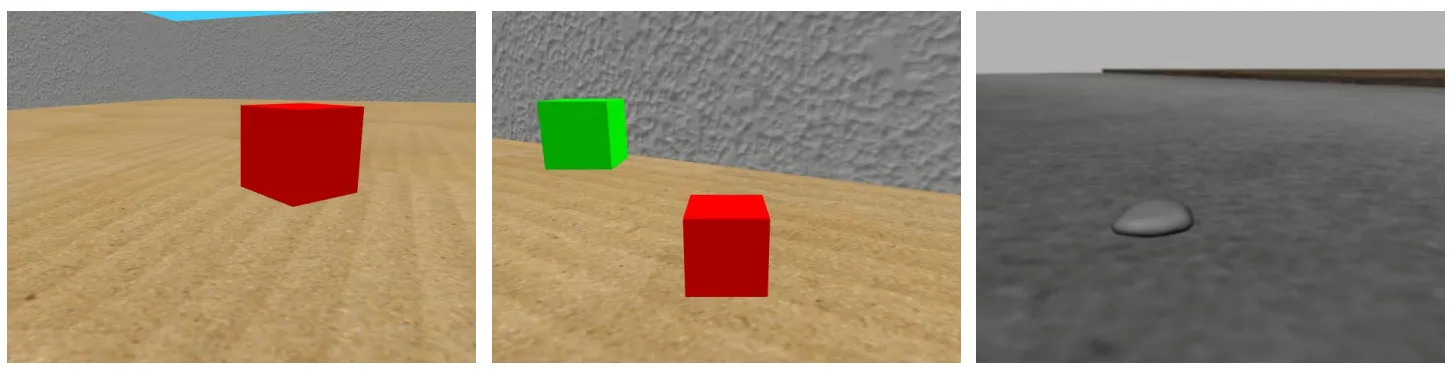
However, there is one problem with applying HER to our robots. Namely — how do we “pretend that , and not , was the intended goal”? In the original HER this was achieved by substituting the end goal configuration — just changing of the intended location does the trick. In the visual domain, the goal state contains an actual visual representation (camera frame) of the environment (Fig 1). In order to pretend that a goal was there, one has to add it to the image.
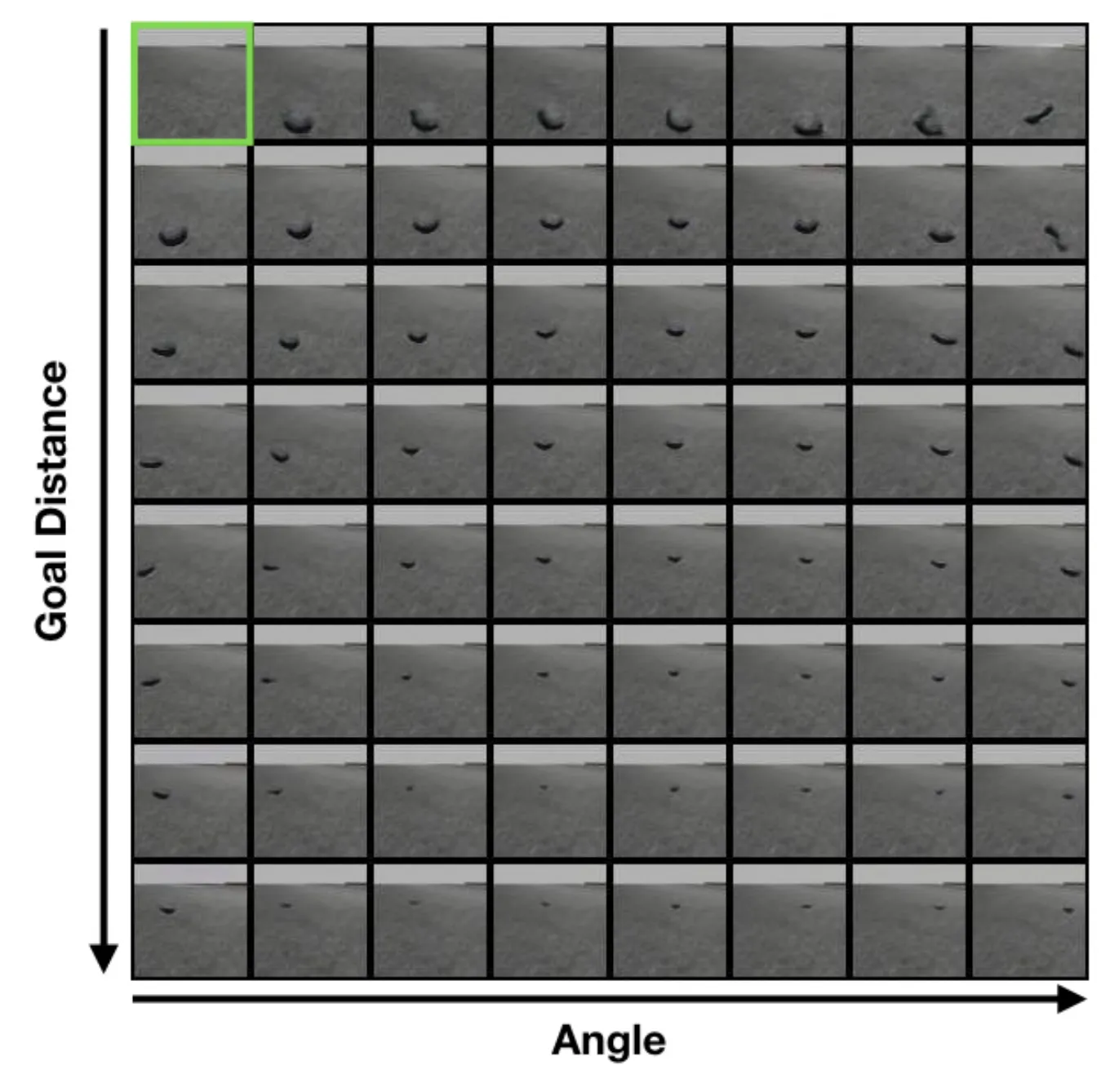
Generative adversarial networks (GANs) are extremely successful in generating images that satisfy the learning objective given to them. For example, if we want to generate an image of the environment with an object added to it, we can train a GAN to hallucinate objects into the frames given a handful of examples (~1000 in our case). Fig 2 shows how HALGAN (the name of our method) generates pebbles at any position within the camera frame.
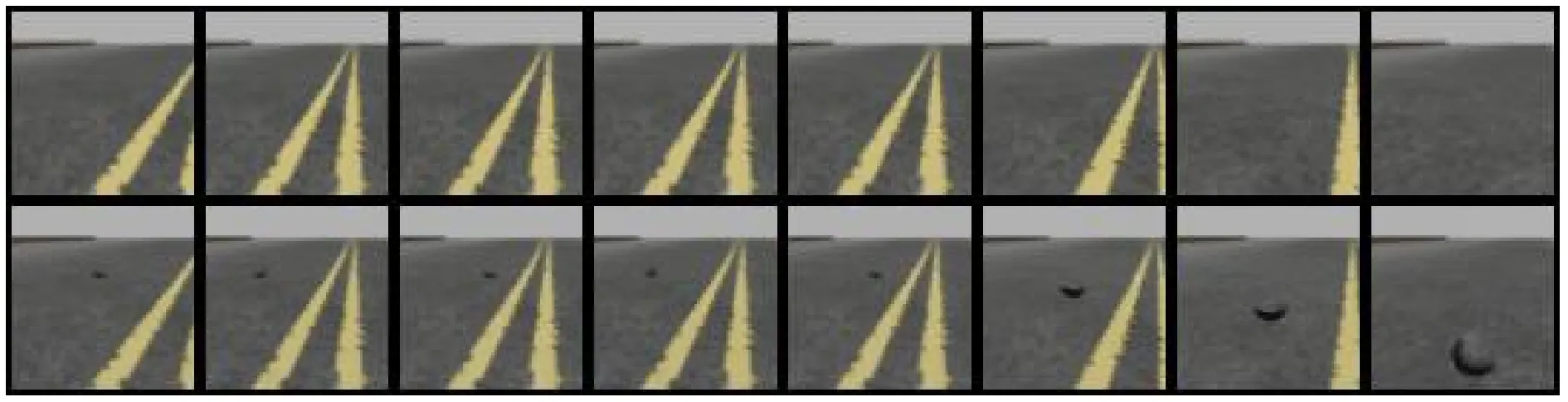
With this functionality we are now able to transform empty trajectories into successful ones (Fig 3). Now we can sample trajectories from the replay buffer and control the percentage of positive learning experiences we want our agent to have.
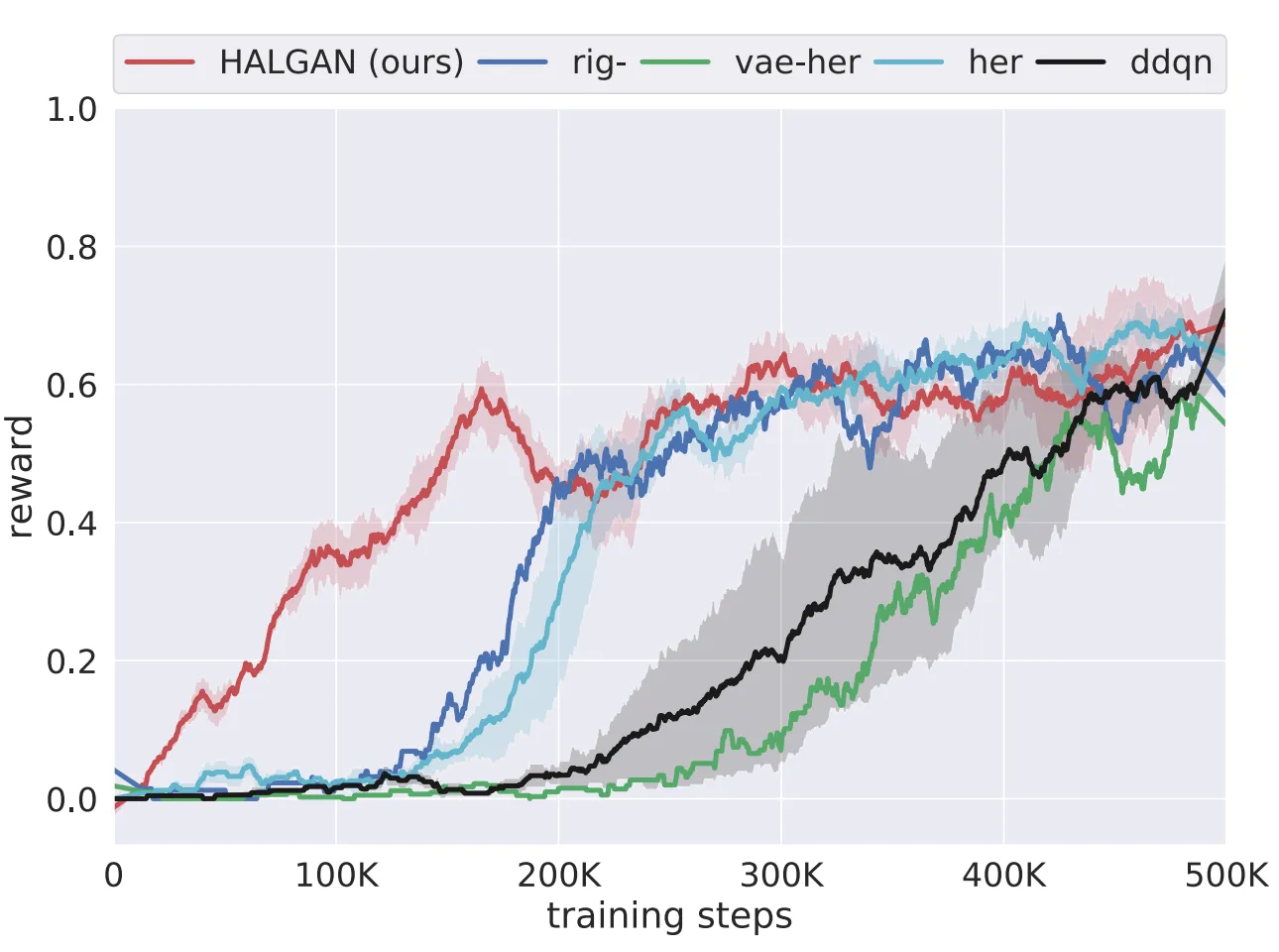
The ultimate purpose of this project was to reduce the sample complexity of the learning process. In our experiment HALGAN allowed for almost a 2x improvement (Fig 4), and for some environments, that are too sparse for naive methods to solve, facilitate a qualitative change towards successful learning by reducing the sparsity of the observed rewards.
For more details please read our paper Addressing Sample Complexity in Visual Tasks Using Hindsight Experience Replay and Hallucinatory GANs by Himanshu Sahni, Toby Buckley, Pieter Abbeel and myself, presented at the ICML 2019 Workshop on Reinforcement Learning for Real Life.